
With the release of The Relic Spell less than week away (!) and a host of responsibilities weighing me down, I haven’t had much chance to work on the second book in The Phyrian War Chronicles. I need to get a move on with it, though, if I want to have it done in a timely fashion and not leave everyone hanging after the first book comes out.
This struggle got me thinking about all the different accountability strategies I’ve tried over the years. I thought I should share them with you in hopes that one or more of them might help keep you on track to accomplish your writing goals!

Note: Writing Partners
The #1 best way to keep yourself accountable, I think, is with a partner. People do this all the time when they have a goal like working out regularly. If you have someone in the trenches with you, trying to meet their own goals, you’re much more likely to stay motivated!
Most of the strategies in this list use writing partners. If you don’t have a writing partner, you can adapt some of the strategies to use on your own.
But if you want to find a writing partner, you’re spoiled for choice! The internet is at your disposal. The Twitter and Instagram writing communities, NaNoWriMo forums, and a variety of online writing groups are great places to find writing partners. For most accountability purposes, you don’t even need to know your writing partners very well or read their work. You just need to be in contact. (It helps me when my writing partners are my friends, though, because I’m more worried about disappointing my friends).
Without further ado, here are five accountability strategies I’ve used with varying degrees of success:
Strategy 1: Deadlines
As any college student staying up all night to finish a paper the day before it’s due will tell you, deadlines are great motivators. If you’re traditionally published, your editor will ask you to have things done by certain times. But for a large portion of your writing life, you won’t have anyone to give you deadlines.
That means you’ll have to give yourself deadlines. One way is with beta readers and editors. You can tell them you’ll have your manuscript or a certain number of chapters ready for them by a given date. They don’t have any actual power, like a professor or a publishing house, so it will be up to you to give importance to the deadline.

If you’re more motivated by the carrot, you can remind yourself that by sending your work to your readers on time, you’ll get feedback on time. If you’re more motivated by the stick, you can remind yourself that if you miss your deadline, your readers might take on another project and have to postpone giving you feedback.
You can also take advantage of submission deadlines for anthologies, contests, fellowships, etc. to get yourself writing.
But what about first drafts that you don’t want anyone to read, but you still want accountability for? Here’s where writing partners come in. You can tell your writing partner(s) that you’ll send them your first draft by a certain date, and they can tell you when to expect theirs. You don’t have to read each other’s drafts—you can even ask each other not to read them because they’re not ready for other eyes. But just the act of sending each other the draft can serve as a deadline to motivate you. If you enjoy competitiveness, you can turn it into a contest to see who can get done faster or who can hit their goal by their appointed time.
Strategy 2: The Grind
I have to give a shout-out to one of my creative writing professors from Warren Wilson College, Rachel Himmelheber, for this strategy!
A lot of times, deadlines aren’t enough to keep you moving through a longer project. Again, think of the college student pulling an all-nighter to finish a project right before the due date. If your deadline is a couple of months away, you might not be motivated to work on it right now.

That’s where The Grind can come in handy. The idea is that every single day for a set amount of time (I’ve done a month, which let me make some good progress despite being in the midst of my last semester in undergrad at the time), you send your writing partner(s) whatever you’ve worked on that day. It doesn’t matter how much you wrote; if it’s just a sentence, that’s okay—though whenever possible, you should try to get more done if your goal is making real progress.
When I was doing The Grind, I was often so busy that I would forget to write or simply wouldn’t have time to do it during the day. When I looked at my phone before going to bed, I would see an email from my writing partners sharing their progress for the day. I would type out a few sentences or a couple of paragraphs on my phone and reply to my partners’ emails, then go to sleep knowing I had made a tiny bit of progress.
The Grind gets exhausting if you do it for longer than a month, so I definitely recommend setting a pre-determined timespan.
Strategy 3: NaNoWriMo
This one’s a no-brainer. If you’re able to join NaNoWriMo in November (when everyone tries to write 50,000 words) or Camp NaNoWriMo in July (when everyone sets their own goal), you should definitely try it out!
Strategy 4: Spreadsheets and Checklists
Out of every strategy on this list, this one is probably the best one to try on your own, though I’ve always enjoyed doing it with a partner. This is also the strategy that’s given me the most mixed results, but I thought I’d still include it because it’s helped me sometimes, and maybe it might work wonderfully for you.
Basically, with this strategy, you’re keeping track of what you write each day (or week) to make sure you’re making progress. You can break down the time you have until a deadline (self-imposed or otherwise) or set a goal, like a certain word count per day/week, a certain number of chapters revised, etc.
One of my writing partners and I have used shared Google Sheets spreadsheets off and on for a couple of years. Here’s a sample of the progress I tracked between January 13th and 27th of this year, when I was working on revising The Relic Spell (each row corresponds to one day of work):
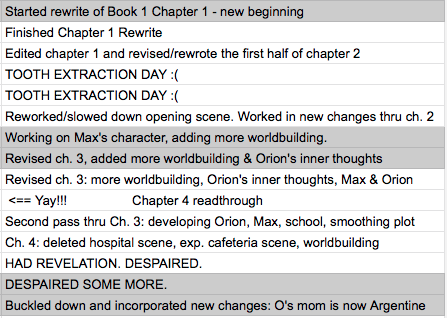
In another column of this same spreadsheet, my writing partner was tracking her progress, so we could see how we were doing in parallel. When the spreadsheet does motivate me, it’s through a combination of wanting to impress my writing partner, a bit of not wanting to let her down, an element of competitiveness, and a smidge of satisfaction at seeing a filled-out spreadsheet.
As you can see, on one of the days I wrote “<== Yay!!!” in response to a milestone my writing partner had written down on her side of the spreadsheet. There’s a lot of camaraderie in seeing what your writing partner is up to and commiserating about your problems, like tooth extractions and unexpected revelations.
Here’s an example of the spreadsheet I’m currently using to keep track of my revision progress for Book 2 of The Phyrian War Chronicles, which is shared with that same writing partner:
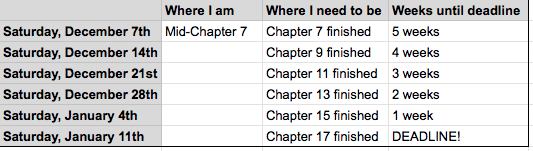
You can see that I opted for weekly rather than daily entries. In this version of the spreadsheet, I have clearly marked goals for each week, as well as my deadline, when I’ve committed to sending my second draft to my writing partner for critique. We’ll see how well this works, but I’m hopeful. I’m excited about my idea to include the “Where I need to be” and “Weeks until deadline” columns, so I can see if I’m on track to finish in time.
Strategy 5: Shared Writing Sessions
Whether in person or online, there’s something magically motivating about having a set amount of time where you’re actually writing alongside someone else.

You see this all the time during NaNoWriMo when Writing Twitter arranges “sprints.” Everyone is supposed to write as much as they can for a period of thirty minutes, twenty minutes, ten minutes. It’s a short burst of productivity that can get you past a block, get your creative juices flowing, or simply allow you to fit some writing into your busy schedule. The key is not to self-edit during this time, but to write as quickly and steadily as possible throughout the sprint.
It’s also been helpful for me to meet up with my writing partners in person, either at a coffee shop or library, and just sitting down and being productive. It’s kind of like going to the gym together (not that I go to the gym). I’m much less likely to goof off and look at Twitter if I’m afraid my writing partner will glance at my screen and judge me. If both/all writing partners are willing, it can turn into a brainstorming session to overcome roadblocks any of you come across. These sessions are usually a few hours long—more of a marathon than a sprint.
Your Strategies?
Do you have any writing accountability strategies that have worked (or not worked) for you? Have you tried any of the ones I suggested, or are you planning on trying them? Drop a tweet or post and don’t forget to tag me!
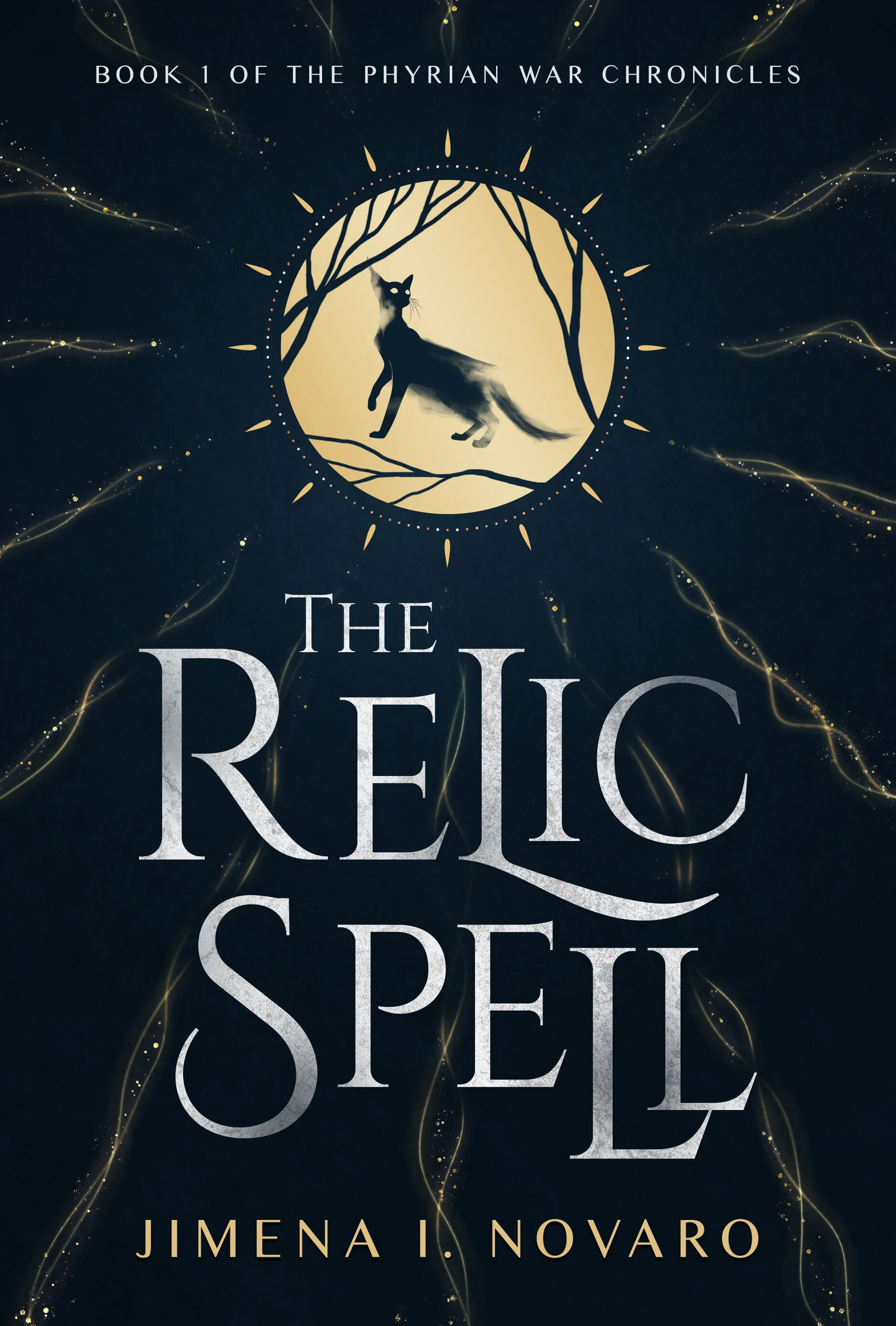
The Relic Spell is still available for pre-order!
I still have one custom tote bag and three custom journals if you want to snag one before they run out! All you have to do is pre-order the book and fill out this form to enter the giveaway.