
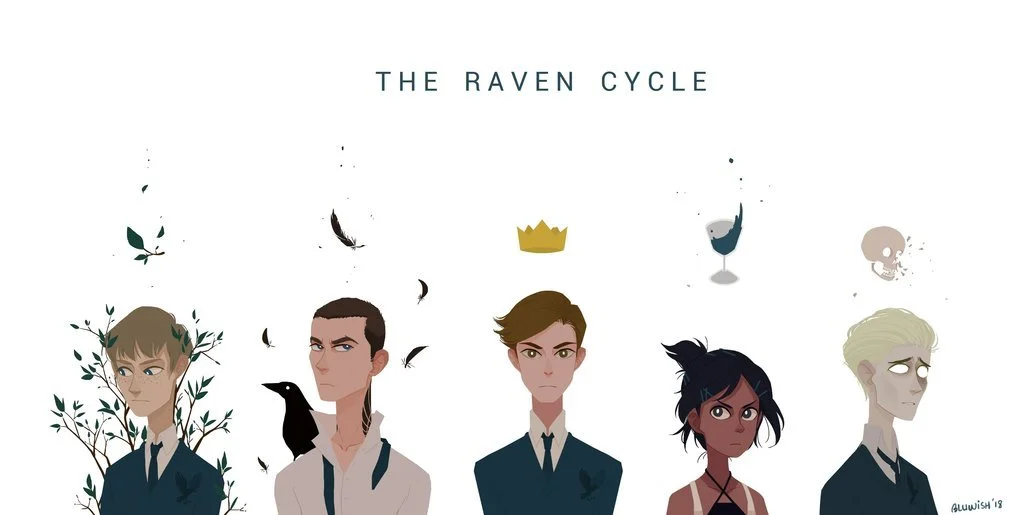
BLuwish (Deviantart)
Maggie Stiefvater’s The Raven Cycle is one of my favorite young adult series of all time. A big part of why I love it so much is the characters: they feel real and complicated in frustrating, beautiful, relatable ways.
As a writer, I’m always trying to learn from what other authors do well. That’s why today I’m taking an in-depth look into how Stiefvater introduces some of her main characters in The Raven Boys, the first book in the series, and sets them up to become fully realized human beings we can fall in love with.
I’m by no means saying this novel’s approach is the only one that works—there’s no one right answer in writing. However, the techniques Maggie Stiefvater uses in the opening pages of the book are worth examining to see if we can learn from them to make our stories more engaging.
I’m going to break down four techniques Maggie Stiefvater uses in the introduction of three main characters and how and why she employs them:
-
She focuses only on these three main characters in their introductory scene, allowing their personalities and relationships with each other to take center stage.
-
She gives selective physical descriptions to show how their outward appearances reflect their personalities.
-
She uses engaging and relevant exposition about each of the boys, filtered through the point of view of one of the main characters, Gansey.
-
Finally, she uses distinctive dialogue between the three friends to establish their rapport.
1. Focus
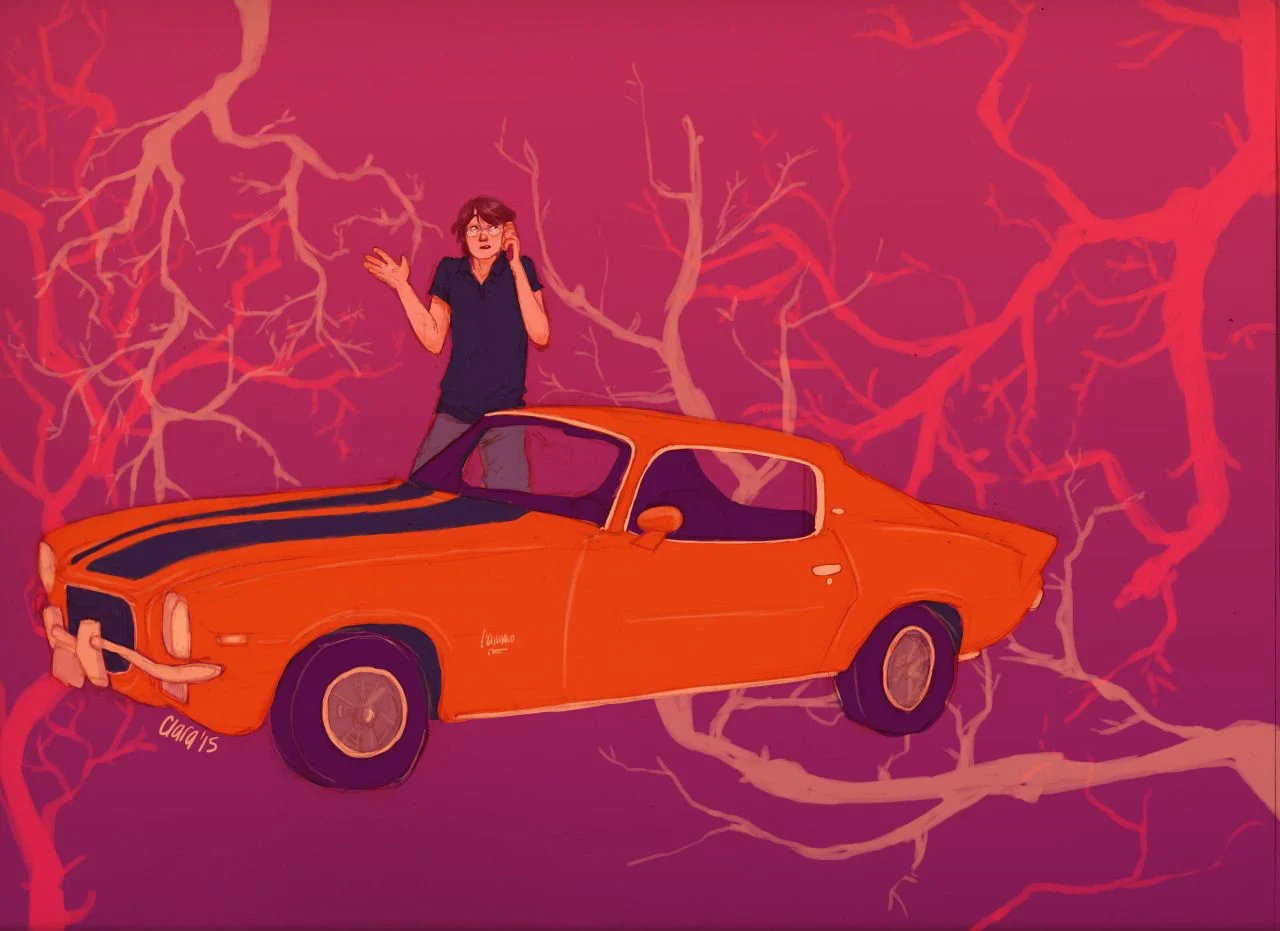
Gansey and his orange Camaro by Hatepotion (Tumblr)
In the second chapter of The Raven Boys, we meet three of the titular boys: Gansey, Ronan, and Adam. The chapter is intensely focused on the three of them. In fact, no other characters play a role in the chapter beyond brief appearances or mentions. This focus allows us to give all of our attention to these three big, distinctive personalities.
We start off with Gansey on his own, dwelling with him in his thoughts as he calls Ronan and Adam to come help him with his car. After he hangs up the phone, we get to explore the objects in the back of Gansey’s car as he searches for his digital recorder. The scene’s focus allows Stiefvater to show us intimately mundane details about his life:
>
“The tiny back of the Camaro was a cluttered marriage of everyday things—a chemistry textbook, a Frappuccino-stained notebook, a half-zipped CD binder with naked discs slithering out across the seat—and the supplies he’d acquired during his eighteen months in Henrietta. Rumpled maps, computer printouts, ever-present journal, flashlight, willow stick. When Gansey plucked a digital recorder out of the mess, a pizza receipt (one large deep-dish, half sausage, half avocado) fluttered to the seat, joining a half-dozen receipts identical except for the date.”
The scene is slow and simple, allowing for this extended description of the contents of his car to feel like an important component of the moment rather than something to gloss over in the middle of action. We have only one character to worry about, so we’re motivated to focus on this description and draw nuggets of characterization from it.
Through these details, we know that Gansey is a bit messy but not a slob, that he’s a creature of habit, that he’s a bit of a traditionalist with his preference for computer printouts rather than tablets or computers, that he’s involved in some unusual activities for a high school student (willow stick? What’s up with that, we wonder?), and that he’s comfortably well-off. We wouldn’t have been able to glean so much information without the scene’s intense focus on Gansey and later on his two best friends.
2. Selective Physical Descriptions
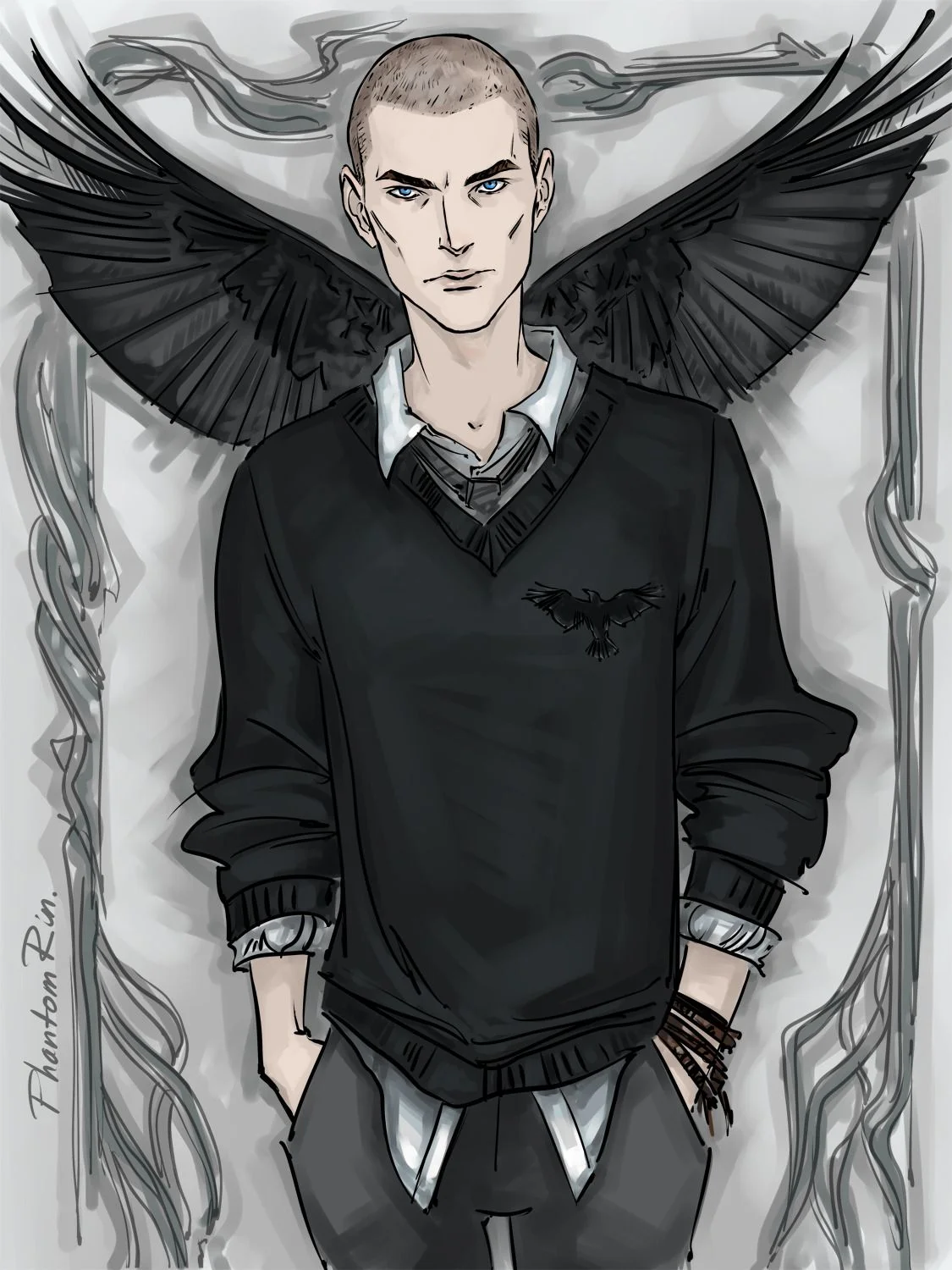
Ronan with raven wings by Phantom Rin (Tumblr)
When we think about character introductions, we often think about describing their physical appearance. Most people notice visual cues from anyone they meet before learning anything else about them, so it makes sense we would frame character introductions through the same lens.
While character descriptions are important to helping them come to life in the reader’s mind, what’s more important than physical traits is what a character’s appearance means. Ronan and Adam get descriptions in this chapter (we don’t get one for Gansey, the point of view character of this chapter, until we see him from an outside perspective) that are mainly focused on their personalities, social statuses, and relationships to each other.
In the following quote, you can see how Ronan is described the first time he comes into the scene:
>
“Ronan hefted a gas tank from the trunk, making little effort to keep the greasy container from contacting his clothing. Like Gansey, he wore an Aglionby uniform, but, as always, he managed to make it look as disreputable as possible. His tie was knotted with an effort best described as contempt and his shirttails were ragged beneath the bottom of his sweater. His smile was thin and sharp. If his BMW was shark-like, it had learned how from him.”
Notice that we don’t learn many details of Ronan’s appearance here—for example, we still don’t know what color or length his hair is, how tall he is, anything about his eyes, etc. It’s not necessarily wrong to include those details, and we do learn several of them later on, but Maggie Stiefvater chooses to describe specific details at this moment that are all about portraying personality.
This paragraph focuses mostly on Ronan’s clothing, in fact, rather than on him. Even though each of the three boys is wearing the same uniform, they wear it in different ways. As private school students, they would be keenly aware of the small differences in each other’s uniforms that mark things like class and personality. This chapter is seen through Gansey’s point of view, so it makes sense that we learn details he would notice.
Ronan is established as a rebel by the way he wears his clothes. He’s also established as wealthy, in contrast to Adam, whose uniform is secondhand but neat and well-kept. From this description, we know he gives the appearance of being dangerous, but we also know from other context clues that Gansey is not terribly impressed with Ronan’s dangerousness.
Ronan’s appearance, then, feels like a deliberate attempt on Ronan’s part to appear tough to the outside world. That’s a lot of important character information to convey through simple description.
3. Engaging and Relevant Exposition
A lot of the “contextual information” I mentioned in the previous point is conveyed through exposition. If you’ve read a lot of writing advice, the word “exposition” might feel dirty to you. It’s often used as a synonym for “telling,” which we’re told is bad. But exposition, like any other technique, is only bad when it turns the reader off. It’s basically a method of conveying information directly to the reader.
From the beginning of The Raven Boys, we know to expect lots of elegant, engaging exposition. The book’s prologue starts off with a zinger:
>
“Blue Sargent had forgotten how many times she’d been told that she would kill her true love.”
Tarot cards from Maggie Stiefvater’s official website.
The rest of the prologue is essentially a history of this prediction and how Blue and her family have dealt with it throughout her life. It’s a block of exposition, but she makes it engaging through clever word choice, bits of dialogue, snippets of scene that include vivid sensory images, and a constant sense of anticipation.
I could write several blog posts dissecting how Maggie Stiefvater makes exposition engaging, and I probably will at some point, but for now what matters is that exposition is a big part of how she develops the world and characters of her story.
In the second chapter, the exposition is mostly focused on characterization and is filtered through Gansey’s point of view. Through bits of exposition nestled in between lines of dialogue and action, we learn nuggets of information about Gansey’s relationship with Ronan and Adam and about his own personality.
When Gansey asks Ronan to come pick him up, we get the following piece of exposition:
>
“Ronan was silent for a long moment. He was good at silence; he knew it made people uncomfortable. But Gansey was immune from long exposure. He leaned into the car to see if he had any food in the glove box while he waited for Ronan to speak.”
Notice that the first and last sentences of the passage I quoted are action sentences: they show us what’s happening in the scene. By sandwiching the exposition, the two middle sentences, between two action sentences, the exposition feels more integrated into the scene.
The exposition is also pared down. We learn as much as we need to know for the scene at hand (in this case, to understand why Ronan isn’t speaking and why Gansey isn’t concerned) and move on. Maggie Stiefvater never provides an overload of exposition because everything she tells us is something we need to know.
Another example comes a bit later, when Ronan and Adam have arrived to help and Gansey is trying to fuel up his car:
>
“Fuel was leeching slowly into Gansey’s expensive chinos, the second pair he’d ruined in a month. It wasn’t that he meant to be careless—as Adam told him again and again, “Things cost money, Gansey”—it was just that he never seemed to realize the consequences of his actions until too late.”
In this case, the exposition is doing something completely different. Instead of telling us something we need to know for the scene, Maggie Stiefvater is using something simple that’s happening in the scene—Gansey spilling fuel on his pants—to make a wider observation about his personality. This wider observation is something we need to know to understand the overall arc of Gansey’s character.
This second example is also interesting because Maggie Stiefvater spices it up by interrupting it with a snippet of remembered dialogue. This strategy makes the exposition more engaging. It also provides characterization for Adam, who is contrasted with Gansey not just because they come from different economic backgrounds but because he’s also Gansey’s opposite in terms of carelessness.
4. Distinctive Dialogue
Perhaps the most pivotal characterization tool used in this chapter is dialogue. Through dialogue, we learn about each of the characters and their relationship to each other. And because there are basically no other characters in this chapter, as I mentioned, the dialogue we hear comes only from the three main characters we’re meeting.
The first thing Ronan says to Gansey—in fact, the first thing he says in the whole novel—is this:
>
“You missed World Hist. I thought you were dead in a ditch.”
In this short line of dialogue, we learn loads of information about Ronan. We learn that he’s direct and blunt. We learn that he’s dramatic and over-the-top. We learn that he cares enough about Gansey to notice that he missed his class and that he might be disguising his worry through apparent insensitivity.
The first thing a character says is important: it’s their absolute first impression. As first lines of dialogue go, this one is impactful. It’s also reinforced by the fact that it’s repeated a few lines later:
>
“[Gansey] asked, ‘Did you get notes for me?’’No,’ Ronan replied. ‘I thought you were dead in a ditch.’”
The first dialogue exchanged between Gansey and Adam, by contrast, is non-verbal, establishing Adam’s much more quiet personality and his close connection with Gansey that allows them to “speak” without exchanging words:
>
“Through the open car door, Adam and Gansey exchanged the briefest of looks. Adam’s knitted eyebrows asked, Did you find anything? and Gansey’s widened eyes replied, You tell me.”
We learn a lot about Adam through this first piece of “dialogue,” too. Unlike Ronan, he shows explicit interest in Gansey’s activities and concern for his friend. His dialogue is focused on Gansey and doesn’t even include himself (unlike Ronan’s dialogue, which is focused on the “I.”) Both boys are worried about Gansey—even a bit obsessed with him, as we slowly discover—but they show it in completely different ways.
Later on, Stiefvater continues to make this distinction. When Gansey talks about the research he was doing the night before, Ronan responds with sarcastic comments, though he shows interest by still listening. Adam engages much more directly with Gansey’s interest in the supernatural:
>
“Now Gansey grinned, the warmth of discovery starting to course through him. ‘So, pop quiz, Mr. Parrish. Three things that appear in the vicinity of ley lines?’’Black dogs,’ Adam said indulgently. ‘Demonic presences.’
’Camaros,’ Ronan inserted.”
Through this continued contrast between Adam and Ronan’s dialogue, each of their personalities becomes more distinctive. That distinctiveness is present from their very first line and is expanded on throughout the chapter. Gansey also becomes more established as a character through his dialogue with them, in which we see his authority and confidence.
Again, through the intense focus on these three characters, we’re able to see how they interact with each other when no one else is present, which is often when relationships feel most genuine. Through the presence of both Adam and Ronan, we’re able to see the contrast between them and their distinctive relationships with Gansey. Characters, like people, often become more defined through the presence of someone who is their opposite.
Implementation
The most important part of any piece of writing advice is how you implement it. I didn’t break down the techniques used in this chapter so you could copy them, but so you could choose the ones that felt applicable to your own work and try them out.
If you’re struggling with how to introduce your main characters, you can try looking at any of these four techniques and seeing if The Raven Boys can serve as a useful model.
-
How crowded or action-packed is the scene where you introduce important characters? Could your story benefit from a quieter, more character-focused scene—not necessarily at the very start of the book, but maybe at some character-establishing point?
-
Are your descriptions of characters focused more on physical characteristics or on how those physical traits reflect their personality? What do you want readers to learn about your characters from the way you describe them?
-
Do characters take any actions that should be explained to the reader through a bit of exposition? Conversely, will your reader be able to keep track of and maintain interest in the exposition that’s present about your characters, especially in the beginning? It can be useful to ask yourself when a particular piece of information needs to be conveyed to the reader. If it can come later, maybe it should.
-
How impactful is the first line of dialogue spoken by each main character? Does it establish who they are from the start, in a way the reader will immediately connect with that particular character? First impressions matter. What aspects of personality and relationships is the dialogue conveying from the start of the story?
I hope you found this discussion helpful and interesting. Did these techniques resonate with you? If you’ve read The Raven Boys, what were your first impressions of the characters? How do you want your readers to feel about your characters at the beginning of your story, and might any of these strategies help you accomplish that? Let me know in the comments or share it in a tweet!